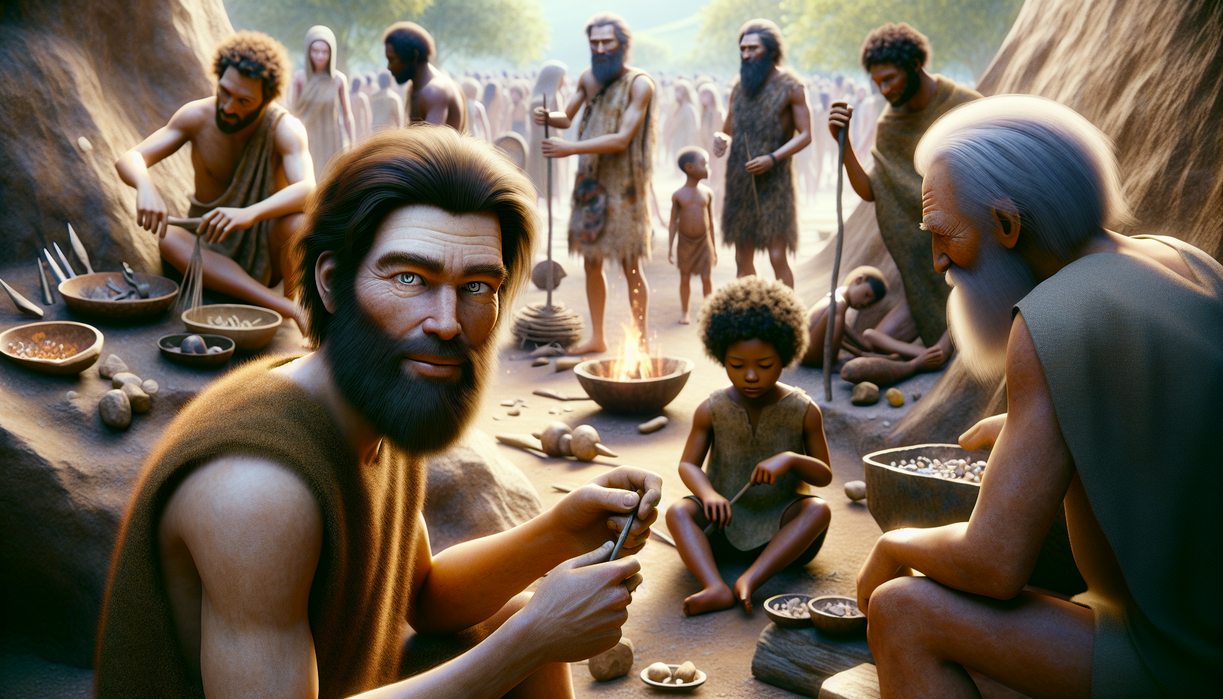
www.socioadvocacy.com – Human evolution has always felt like a story told through fragments: a tooth here, a femur there, DNA traces frozen in tiny bones. For decades, scientists debated how these scattered clues fit together, yet the broader context of our origins stayed blurry. In 2025, a breakthrough shifted that uncertainty. Researchers finally reconstructed the face of a mysterious ancient human cousin, turning abstract debate into something tangible, recognizable, and deeply personal.
This new face does more than satisfy curiosity. It reshapes the context for almost every question about where we come from, how we spread across the planet, and why our species survived while others vanished. Once just lines on evolutionary trees, these early relatives now feel like real individuals. That shift—from numbers to someone—changes how we understand both science and ourselves.
A Face Emerges From Fragments
For years, one of the deepest puzzles in human evolution centered on an elusive population known only through a handful of fossils and genetic hints. No complete skull, no clear profile, just scattered remains and faint DNA echoes. Researchers knew this group influenced our ancestry, yet its identity remained faceless. The 2025 reconstruction changed that context by merging high-resolution imaging, 3D modeling, and advanced genetic techniques.
Researchers began with partial bones recovered from a cave site placed at a strategic crossroads of ancient migration routes. Each fragment told a small part of the story: brow ridges, jaw curvature, inner ear shape, dental pattern. On their own, these pieces lacked context. Together, under powerful computers, they revealed underlying geometry of a skull that belonged to neither modern humans nor classic Neanderthals. Subtle anatomical details hinted at unique dietary habits and environmental pressures.
To refine the reconstruction, scientists integrated genetic forecasts about facial structure, similar to methods used in forensic science yet tailored to ancient DNA. They mapped how certain gene variants influence nose width, facial projection, and skull volume. This genetic context did not deliver a photograph, but it offered probabilities and constraints. After countless iterations, a face emerged: familiar yet distinctly other, with features reflecting survival in colder climates and rugged terrain. For the first time, we could look into the eyes of a population long discussed only as data points.
Why Context Transforms the Story
Seeing this ancient face reframes our origin story because context turns isolated facts into narrative. Before the reconstruction, many people imagined evolution as a linear march: apes to cavemen to us. The new evidence shows a far more branching, tangled process. Several human groups overlapped across time and landscape, exchanging genes, competing for resources, sometimes cooperating. The face reminds us we are not the inevitable apex of a simple ladder, but one surviving twig on a rich evolutionary bush.
Context also shifts how we interpret behavior. A reconstructed skull can suggest brain volume and sensory adaptation. Combined with archaeological layers, it links tool styles, fire use, or symbolic objects to a specific group. Suddenly, crude stone flakes on a cave floor belong to someone, not just some vague ancestor. That connection makes it easier to imagine conversations around fires, teaching children, sharing hunted meat, negotiating alliances. Science squeezes abstract evolution into the lived context of daily life.
Personally, I find this change both humbling and grounding. When we place ourselves in proper context, our modern problems feel smaller, though not insignificant. Climate change, social conflict, rapid technology growth—none of these issues exist in isolation. They sit on top of hundreds of thousands of years of adaptation, cooperation, and crisis. This new face becomes a mirror for our own choices. Our distant cousins met shifting climates, dangerous predators, scarce resources. Some lineages disappeared. Ours did not. That survival rests on traits we still rely upon today: creativity, shared knowledge, flexible social bonds.
What This Means for Our Future Context
Looking forward, this breakthrough invites a broader shift in how we think about human identity and responsibility. Evolutionary discoveries often get framed as distant curiosities, yet they carry deep ethical weight. When we recognize that our species emerged from a web of related groups—many of them capable, intelligent, emotionally rich—it challenges simple notions of human superiority. It urges a new context for how we treat each other, other animals, and the planet that shaped us. For me, the most powerful outcome of seeing this ancient face is not the thrill of mystery solved, but the realization that we now stand in a long chain of lives, each link carrying hope and risk forward. Our task is to honor that inheritance by making choices future generations will consider wise, compassionate, and worthy of the long story that led to them.