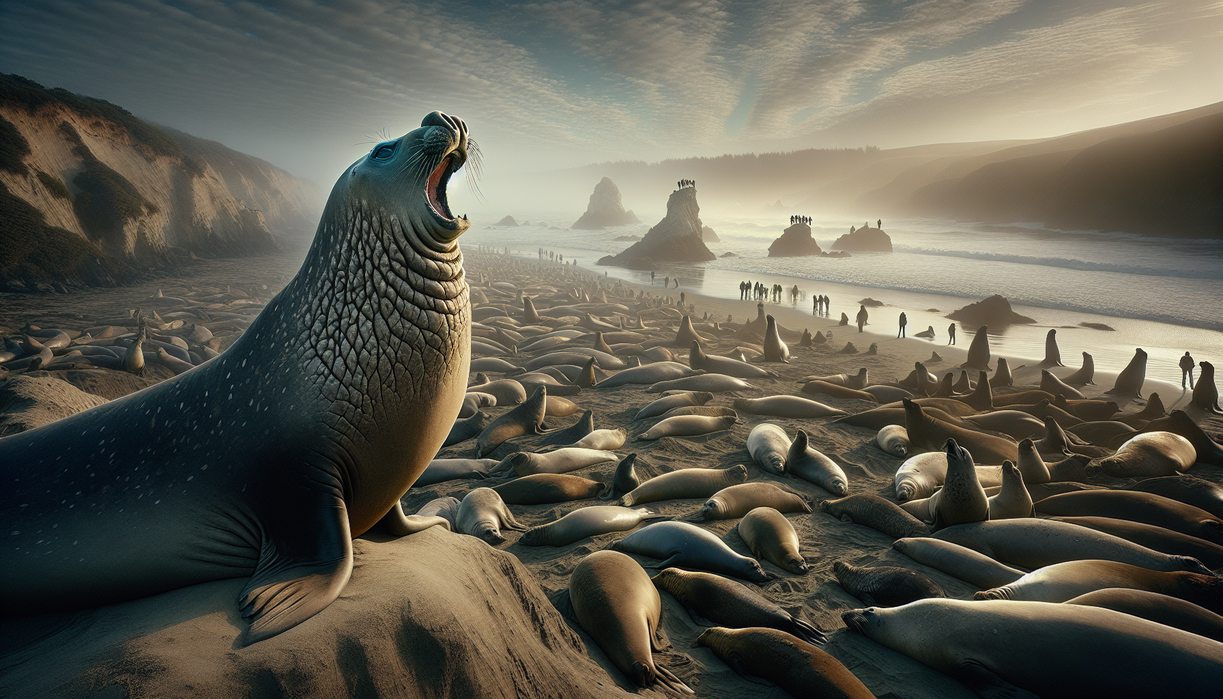
www.socioadvocacy.com – Each winter, the raw ecology of California’s central coast erupts into view at Año Nuevo State Park. Thousands of elephant seals pour onto the beaches, turning quiet coves into a living amphitheater of sound, struggle, birth, and survival. For visitors, it is more than wildlife watching; it is a front‑row seat to the forces that shape life by the sea.
This temporary colony highlights how fragile ecology can be, yet also how resilient. Massive bulls roar, females nurse newborns that weigh as much as 75 pounds, and scavengers wait at the edges for their chance. Every interaction fits into a larger coastal web, where wind, surf, sand, and climate shape what unfolds on the shore.
Ecology on Display at Año Nuevo
When elephant seals return to Año Nuevo, the park becomes a seasonal laboratory of marine ecology. Over 10,000 animals may crowd these beaches between December and March. Their presence reshapes the landscape: dunes flatten, vegetation compresses, trails shift. The colony turns abstract ideas about food webs and habitat into something you can see, hear, and smell from only a few meters away.
This dense gathering reveals how ecology operates across scales. Each pup depends on a mother’s rich milk, each mother relies on fat reserves built in the open ocean, and the ocean itself responds to currents, temperature, and prey distribution. A single nursing scene on the sand connects directly to distant feeding grounds hundreds of miles offshore.
Visitors who come for drama often leave with curiosity about ecology. Why do bulls fight so fiercely? Why are some pups plump while others struggle? Guides explain how dominance, timing, genetics, and ocean conditions intertwine. The result is a living narrative, where every scar, call, and movement tells part of a broader environmental story.
Battling Bulls and Breeding Strategies
The first sign of the season’s intensity comes from the dominant males, or bulls. Weighing more than a small car, they haul out early to claim territories. Their bodies carry deep claw marks, teeth scars, and history. When rivals approach, their booming calls roll across the beach. These confrontations are not random violence; they reflect a clear breeding ecology based on hierarchy, energy, and risk.
Only a small fraction of bulls will sire most of the pups, which concentrates reproductive success. That skew shapes the colony’s genetic future. From an ecological perspective, each clash over territory is also a contest over whose traits persist. Observers see blood and sand flying; biologists see selective pressure at work. The beach doubles as a battlefield and as an engine of evolution.
Yet brute strength is not the only survival strategy. Subordinate males sometimes sneak matings at the edges of harems. This behavior reveals another layer of ecology: alternative tactics that reduce direct conflict but still pass genes forward. Watching from a safe distance, I often find myself mapping each move as if it were a complex social chess game, shaped by biology, scarcity, and opportunity.
Newborn Pups and the Coastal Web
Then come the births. Tiny compared with the hulking bulls yet already hefty, the pups lie close to their mothers on the sand. Their survival depends on timing, maternal condition, and a broader coastal ecology that begins long before either set flipper on the beach. Each nursing session transfers energy accumulated from deep‑sea foraging into a new generation on shore. Gulls, ravens, and sometimes coyotes hover nearby, ready to scavenge any remains. Even the wind plays a role, chilling wet pups or cooling overheated bodies. Watching these scenes, I am reminded that ecology is not a static backdrop; it is a living system of exchanges, where every wave, footprint, and breath influences what the future coastline will hold. In that sense, every visitor walking the trail becomes part of this web, with a responsibility to tread lightly and remember that awe should lead to care.