www.socioadvocacy.com – Molecular biology is rewriting how many African Americans think about kinship, ancestry, and the word “cousin.” New research combining molecular biology with mathematical models suggests that large numbers of Black Americans who share similar ages may also share ancestors from only a few centuries ago. This insight reaches far beyond casual slang; it reshapes ideas about community, history, and identity.
By tracing how genes spread through time, scientists use molecular biology to map invisible links across generations. For African Americans, whose family trees were often fractured by slavery, migration, and incomplete records, these models offer something powerful: evidence that everyday neighbors may be literal relatives. The science does not just count ancestors; it reframes what family might truly mean.
The science of kinship through molecular biology
Molecular biology gives researchers tools to track shared DNA segments and estimate how far back common ancestors lived. When those tools are merged with population genetics and probability theory, they form a powerful lens on African American heritage. Instead of depending only on written records, scientists can infer how closely connected people may be, based on how their genes match across the genome.
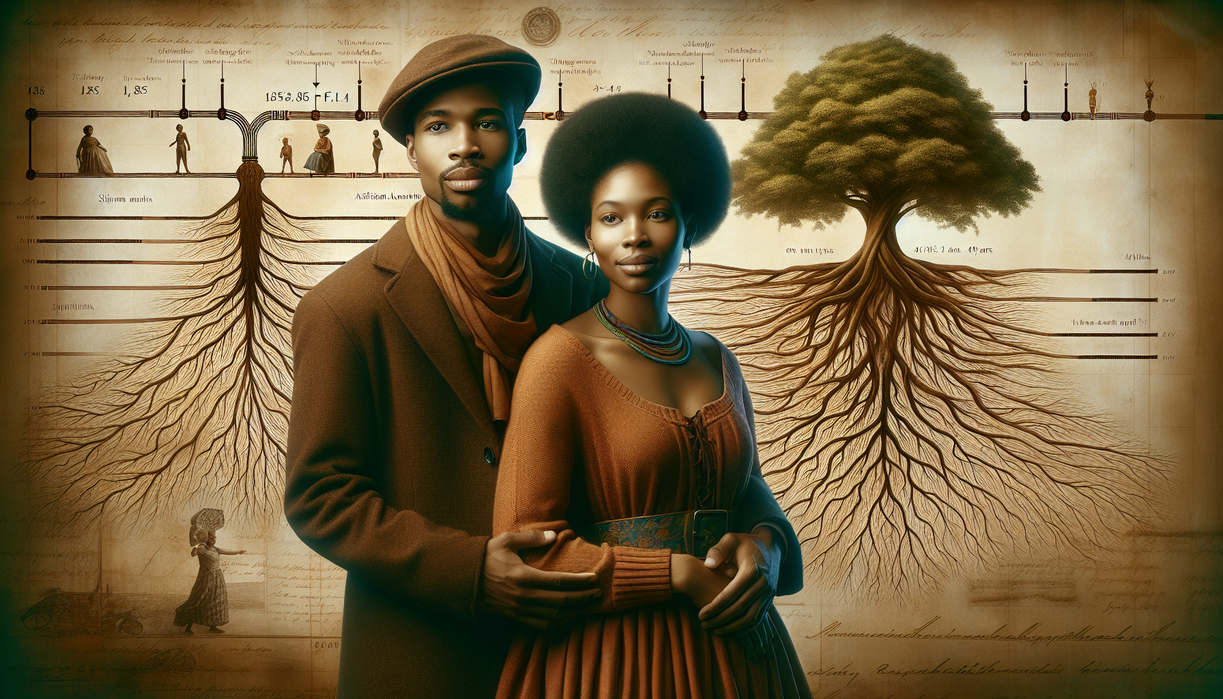
In the new modeling work, many same-age African American pairs appear to share at least one ancestor who lived roughly 185 to 410 years ago. That time window spans the late 1600s through early 1800s. It includes the height of the transatlantic slave trade and the era when forced displacement, sale, and family separation were widespread across the American South and Caribbean.
Because of that cruel history, written family records for Black communities are often sparse or broken. Molecular biology steps into that silence with measurable evidence. Genetic similarities, when processed through careful math, show that countless people who might greet each other as “cousin” in casual speech may also share a literal genealogical link from only a few centuries in the past.
From slang to science: what “cousin” really captures
Among many African Americans, the word “cousin” has long served as a flexible social label. It can include close friends, neighbors, church members, or people who share roots in the same town. This habit did not start with molecular biology. It emerged from cultural survival, mutual support, and the need to rebuild extended families shattered by slavery and discriminatory policies.
What is striking now is that molecular biology indicates this social habit often contains literal truth. When two Black Americans of similar age call each other “cuz,” there is a good chance some shared ancestor lived only a few generations back. That does not mean they are second cousins in the strict legal sense. Yet, in a broader genealogical picture, the kinship is real rather than imaginary.
From my perspective, this makes the word “cousin” feel almost prophetic. Community language anticipated what molecular biology has now validated. Black communities treated one another as kin for cultural reasons long before anyone could quantify genetic overlap. The science, surprisingly, ends up affirming a social instinct that was rooted in experience, not in laboratory data.
Why so many shared ancestors exist
Mathematical models combined with molecular biology reveal that humans share far fewer distinct ancestors than most people assume. Family trees branch outward exponentially, yet real historical populations remained limited in size. Many ancestors occupy multiple branches of our trees. For African Americans, a history of forced movement, restricted marriage choice, and concentrated communities made shared ancestors even more likely. Elders might have guessed this intuitively. Modern genetic analysis now spells it out with numbers.