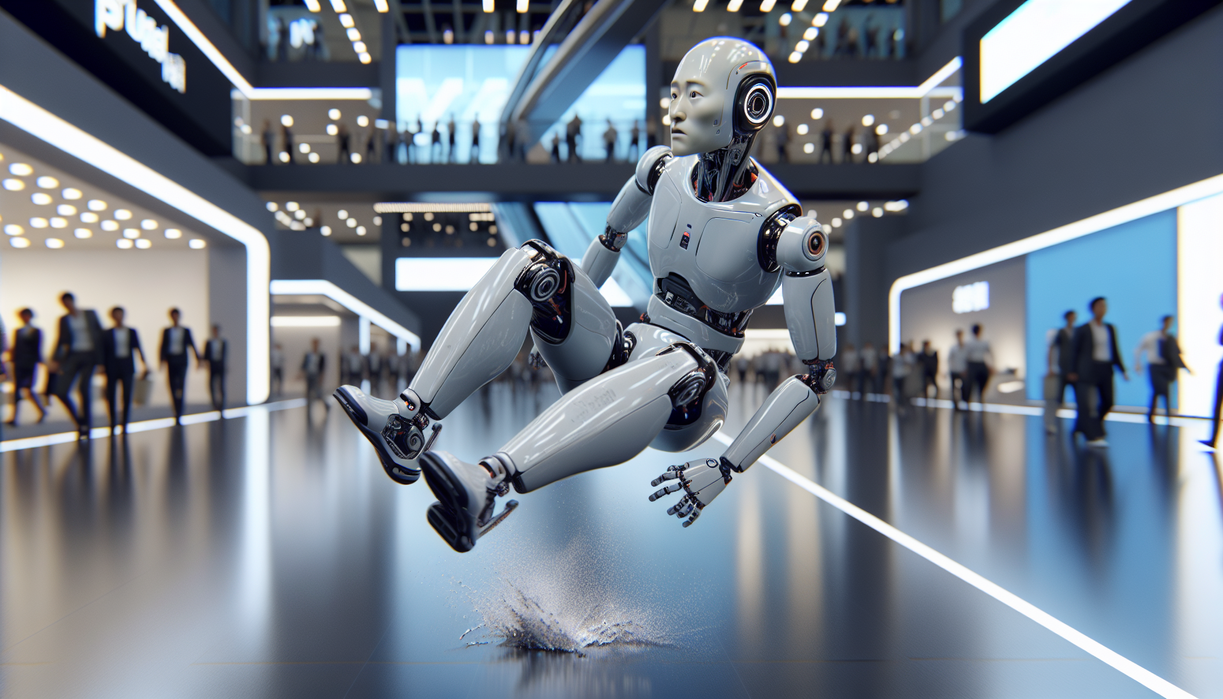
www.socioadvocacy.com – Robotics just delivered a loud reminder that progress often arrives with a crash, not a quiet applause. During a recent Chinese demonstration, a humanoid robot tried a dramatic twist, lost balance, and faceplanted with a heavy thud that echoed across social media feeds worldwide.
The brief clip, oddly funny yet fascinating, has become an unexpected milestone in robotics. Watching the machine wobble like a toddler taking first steps reveals how close, and still how far, humanoid design remains from natural human movement. This single stumble says more about the state of robotics today than a dozen glossy marketing videos.
When Robotics Meets Gravity: The Viral Faceplant
In the demo, the humanoid robot attempts a turning motion that looks almost like a dance move. For a moment, robotics enthusiasts might feel impressed. The machine rotates its torso, shifts its weight, and appears to manage a controlled twist. Then, in a heartbeat, physics asserts control. Its balance falters, knees buckle, and the robot slams into the floor with a sound that instantly breaks the illusion of effortless grace.
That thud matters. It highlights a core truth about modern robotics: making a machine walk is hard, but making it recover from mistakes is much tougher. Our nervous systems constantly adjust to tiny slips, uneven surfaces, and unexpected pushes. Robots, guided by code and sensors, still struggle to match that adaptability. Each misstep exposes the gap between biological control systems and engineered ones.
The viral nature of the video also exposes another layer of this story. People love seeing advanced robotics fail. It feels disarming, even reassuring. The spectacle of a humanoid robot falling on its face transforms abstract fears about super-intelligent machines into something more grounded. For now, the robots trying to mimic us are still learning how to stay on their feet.
Why Walking Is Still the Hardest Trick in Robotics
Walking seems trivial to humans, yet it remains one of the toughest challenges in robotics. A human body constantly juggles balance, momentum, and muscle control. Each step requires complex calculations, even if we never notice them. For a humanoid robot, those same actions involve algorithms, motor control, and sensor integration that must work together in perfect timing.
Robotics engineers try to give machines a stable gait, but real environments are unpredictable. Floors may be slightly uneven, friction changes across surfaces, and small delays in calculation can cause huge instability. In the Chinese demonstration, the twist move probably pushed the robot near the edge of its control envelope. Once its center of mass shifted too far, recovery became impossible. Gravity finished the job.
From my perspective, this failure is not embarrassing at all. It is evidence of ambition. Safe, simple movements often mean conservative robotics design. Risky maneuvers, even unsuccessful ones, indicate a team willing to confront difficult control problems. The faceplant is a snapshot of robotics maturity: advanced enough to attempt a complex motion, but not yet refined enough to complete it every time.
Falling Forward: Failure as Fuel for Future Robotics
There is something deeply human about watching a robot fall, then realizing that each crash pushes robotics a step ahead. Engineers replay these moments frame by frame, refine balance algorithms, adjust joint torque, and improve sensor fusion. The next demo will show smoother motion, fewer wobbles, and better recovery from slips. Today’s viral stumble becomes tomorrow’s training data. As robotics marches toward more capable humanoids, these loud, awkward failures remind us that innovation rarely looks polished in real time. It is messy, noisy, and occasionally face-first on the floor. Yet that is exactly how meaningful progress has always been made.