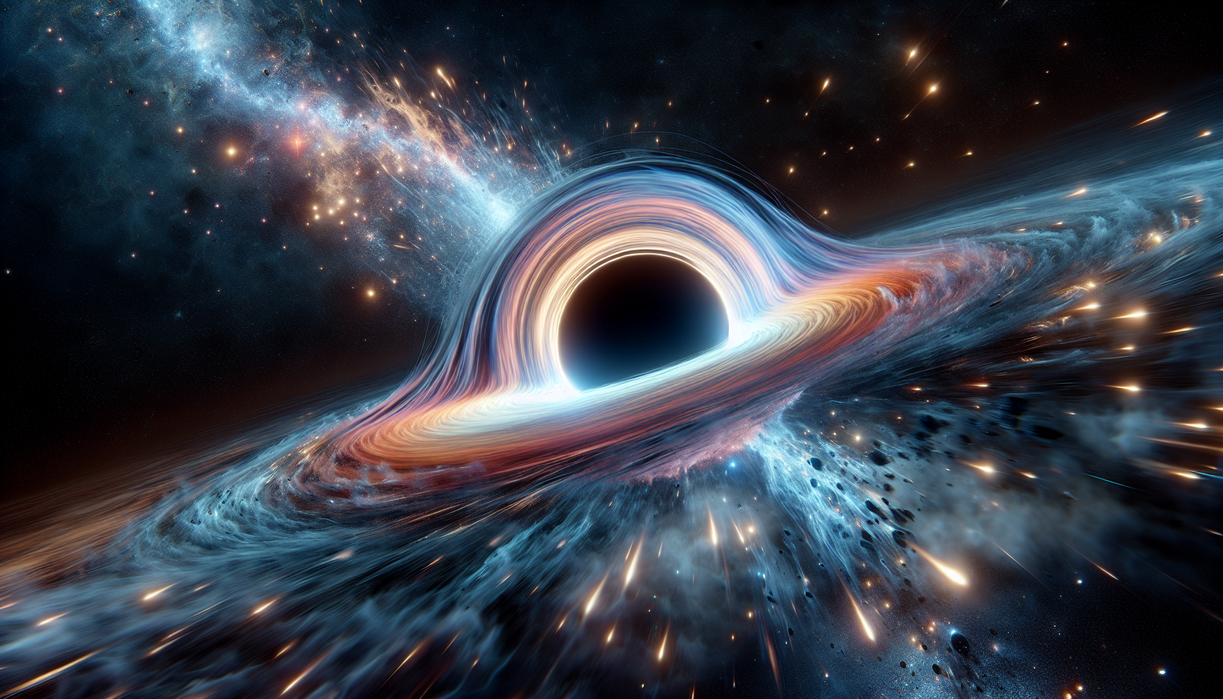
www.socioadvocacy.com – Astronomy just confirmed one of its boldest ideas: a supermassive black hole has been caught fleeing its home galaxy at breakneck speed. Thanks to the James Webb Space Telescope, researchers now have powerful evidence for a runaway black hole dragging a brilliant wake of newborn stars behind it. This discovery reshapes how astronomy views the lives of galaxies, because it shows their central monsters are not always anchored forever at the core.
Instead of staying put, this immense object seems to have been kicked so hard it now streaks through space like a cosmic cannonball. For astronomy lovers, this is more than a spectacular image. It is a test of our deepest models for gravity, galaxy evolution, and the violent encounters between black holes that can reshape entire cosmic neighborhoods.
Astronomy Meets a Galactic Crime Scene
From an astronomy perspective, this runaway supermassive black hole looks like a crime scene frozen in space. The central galaxy appears oddly quiet, almost abandoned, while a long, thin streak of light stretches away from it. At the far end of that trail sits a dazzling knot of brightness, likely the black hole itself, moving so fast that it plows through gas and sparks star formation along its path.
Earlier telescopes had spotted a strange linear feature, yet the evidence seemed ambiguous. Some astronomers wondered whether it might be a jet from an active black hole still anchored to the galaxy. Others suspected a tidal tail produced by a galactic encounter. JWST’s sharper vision changed the conversation. Its detailed infrared view resolved clusters of young stars along the trail, revealing a structure far more consistent with a fleeing heavyweight object.
In astronomy, morphology tells stories. A classic jet from a stationary black hole tends to show narrow, steady emission dominated by energetic particles. By contrast, this streak looks like a chain of star nurseries, ignited as the black hole barrels through cold gas. That pattern strengthens the case for a gravitational kick so extreme it ripped the black hole out of the galactic center, leaving a luminous scar through space as evidence.
The Violent Physics Behind a Runaway Giant
What kind of event could throw a supermassive black hole out of its own galaxy? Modern astronomy points to the most dramatic encounters possible: mergers of black holes under complex gravitational conditions. Picture three supermassive black holes entangled in a gravitational dance, likely due to previous galaxy mergers. Their orbits twist, energy redistributes, and one object receives a slingshot-style kick, like a cosmic billiard shot played with gravity instead of cues.
Another scenario uses gravitational waves as the engine. When two black holes coalesce, they radiate gravitational waves asymmetrically. That radiation carries momentum. If more energy bursts out in one direction, conservation laws demand a recoil in the opposite direction. For stellar-mass black holes, this kick might be modest. For supermassive ones, the recoil can reach thousands of kilometers per second, enough to escape even a massive galaxy’s gravitational pull.
Astronomy models have predicted these kicks for years, yet proof remained elusive. Most galaxies sit far away, so their central regions appear tiny, even to powerful telescopes. JWST’s sensitivity and resolution finally provide a window fine enough to catch black holes in the act of escape. The runaway now under scrutiny gives theorists a rare reality check: their simulations do not just produce abstract numbers; they describe events unfolding across real cosmic landscapes.
Why This Runaway Matters for Future Astronomy
From my perspective, this discovery marks a turning point for astronomy as a whole. It shows that galactic centers can lose their anchors, potentially leaving quiet cores without active black holes while seeding intergalactic space with rogue giants. That possibility forces scientists to reconsider growth histories of galaxies, rates of black hole mergers, and expectations for future gravitational-wave observatories. More personally, it reminds us that the universe is far less orderly than textbook diagrams suggest. Even its heaviest objects can be kicked out, cast into lonely trajectories that stretch across millions of light-years, writing their stories as luminous trails for astronomy to decode. In that sense, this runaway is not just an oddity; it is a message about a cosmos built on motion, imbalance, and surprise.