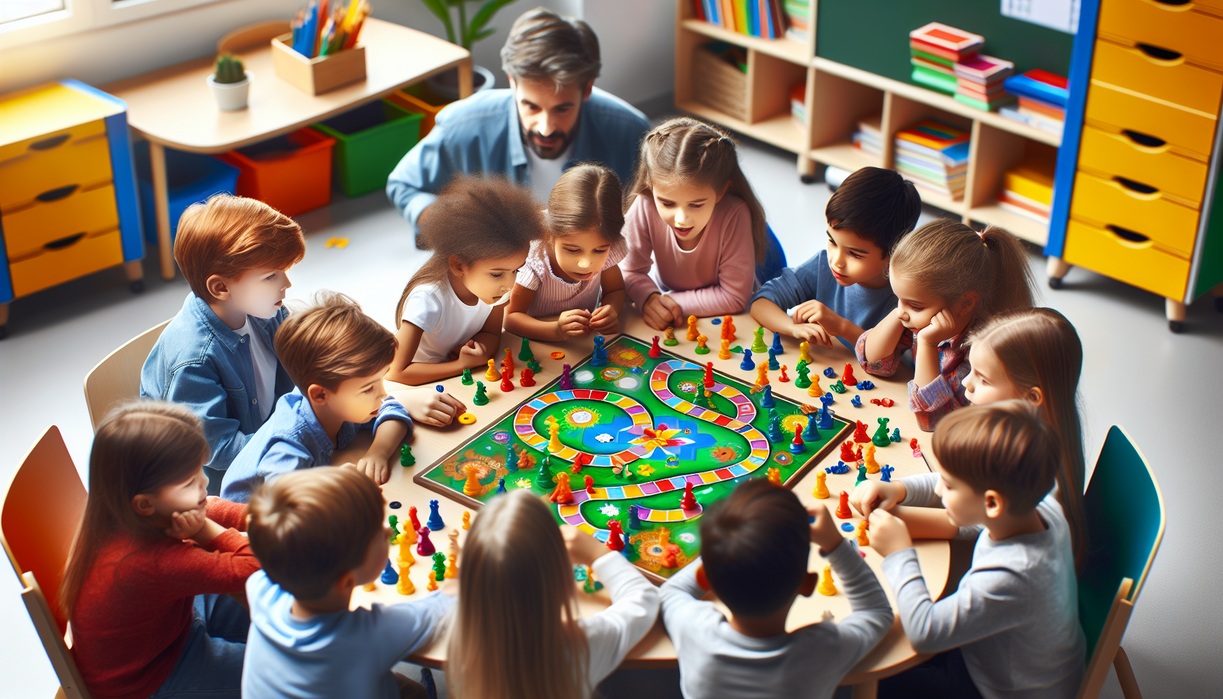
www.socioadvocacy.com – Parents often search for powerful yet playful ways to support early education, especially around math. A growing body of research now points toward an unexpectedly simple tool: classic number-based board games. Instead of flashcards or apps, these familiar games place learning right on the kitchen table, turning ordinary family time into rich numerical exploration.
A new report from the HEDCO Institute highlights how linear number board games can strengthen young children’s math education. These games feature a track marked with numbers, plus a token that moves step by step. As kids count spaces, compare positions, then talk about bigger or smaller numbers, they quietly build skills future teachers will rely on in preschool and early elementary classrooms.
Why Number Board Games Matter For Education
Linear number board games use a path of numbered squares, usually starting at one and moving toward a clear finish. Children roll a die or spin a spinner, count aloud, then shift their piece along the track. Every turn invites them to connect counting sequences with physical distance, rather than just reciting numbers like a song.
Research reviewed by the HEDCO Institute suggests these simple mechanics have serious education benefits. Young players show improved number recognition, stronger understanding of quantity, and better grasp of numerical order. Instead of abstract worksheets, children experience numbers as locations on a path, closely tied to movement, progress, and success inside the game.
Those improvements do not stay on the game board. Studies report transfer to broader math education outcomes, such as early addition, comparison of larger versus smaller values, and more accurate mental number lines. When children repeatedly practice these ideas through play, the concepts begin to feel intuitive rather than forced. Over time, that foundation supports more formal instruction at school.
From Living Room Play To Classroom Education
For teachers, the report’s findings open a practical doorway between home play and classroom education. Instead of viewing board games as a Friday reward, educators can integrate them as core tools for math exploration. A short game at the start of a lesson can prepare brains for number work, while reminding children that learning can feel playful.
In my experience observing early education settings, children quickly gravitate toward any activity involving dice, colorful tokens, and a race to the finish. When teachers choose games with clear numerical tracks, every excited roll becomes a tiny math lesson. Even brief sessions can reinforce counting skills, one-to-one correspondence, and early ideas of addition as movement forward.
This approach also supports diverse learners. Children who struggle with worksheets may thrive during structured games, where rules feel clear and feedback appears immediately. Those who already excel at math can still stretch understanding by predicting outcomes or explaining strategies to peers. Well-chosen games offer a shared education experience, while still allowing flexible levels of challenge.
Practical Tips For Parents Supporting Early Education
Parents rarely need expensive materials to tap into these education benefits. Look for or create a simple board with a numbered path, a die, and a few tokens. During play, encourage your child to count each step out loud, ask which number comes next, or compare positions using words like “ahead,” “behind,” “more,” or “less.” The goal is not to win every time but to help your child link number words to locations, distances, and choices during an engaging shared activity. Over months, this gentle routine can quietly build math confidence, while also nurturing a positive emotional connection to education as a whole.
Beneath The Surface: What Kids Really Learn
On the surface, board games look like pure entertainment. Children roll dice, cheer when they move ahead, groan when luck turns against them. Underneath that drama, important education processes unfold. Every counted move anchors number words to specific spaces on the track, strengthening the link between language and quantity.
One powerful idea supported by linear tracks is the mental number line. Children begin to picture numbers arranged from smaller to larger, left to right or along a path. That visualization later supports estimation, place value understanding, and even fractions. When a child sees their token leap from three to six, they experience a physical example of addition, not just a written equation.
These games also sharpen attention, impulse control, and turn-taking, social skills central to classroom education. Waiting for a turn, following rules, then handling disappointment after an unlucky roll prepares children for group learning. So even when the focus seems purely numerical, the broader cognitive and social benefits should not be underestimated.
My Perspective: Why Play Belongs At The Heart Of Education
From my perspective, the most exciting aspect of this research lies in what it suggests about the future of education. Too often, early math instruction leans heavily on drills or digital tools. Board games remind us that children learn best when curiosity, movement, and emotion fuse into a single experience. A tense race to the final square carries more meaning than another worksheet ever could.
Many caregivers worry they lack the training to support math education at home. Number board games lower that barrier. You do not need a teaching degree to roll a die, count together, then talk about who is ahead. The structure of the game guides the learning. Adults simply provide encouragement, model clear language, and stay present during play.
I suspect the real potential here lies not just in specific games, but in a mindset shift. When families and schools treat play as a central driver of education rather than a break from it, they unlock powerful motivation. Children begin to see math as something they do with people they love, during moments they enjoy. That emotional layer may be the strongest predictor of long-term success.
Looking Ahead: Rethinking Early Education Through Play
As research on board games and math skills continues to grow, we face a larger question about education priorities. Will we keep viewing learning as a serious activity separated from play, or will we embrace playful tools as essential vehicles for deep understanding? Linear number board games offer a clear example of how simple, low-cost activities can enrich early education by uniting emotion, movement, social interaction, and numerical reasoning. Reflecting on this evidence, I find myself drawn to an education vision where families roll dice together, teachers design lessons around meaningful games, and children build strong math foundations through laughter, suspense, and shared stories around a humble cardboard track.