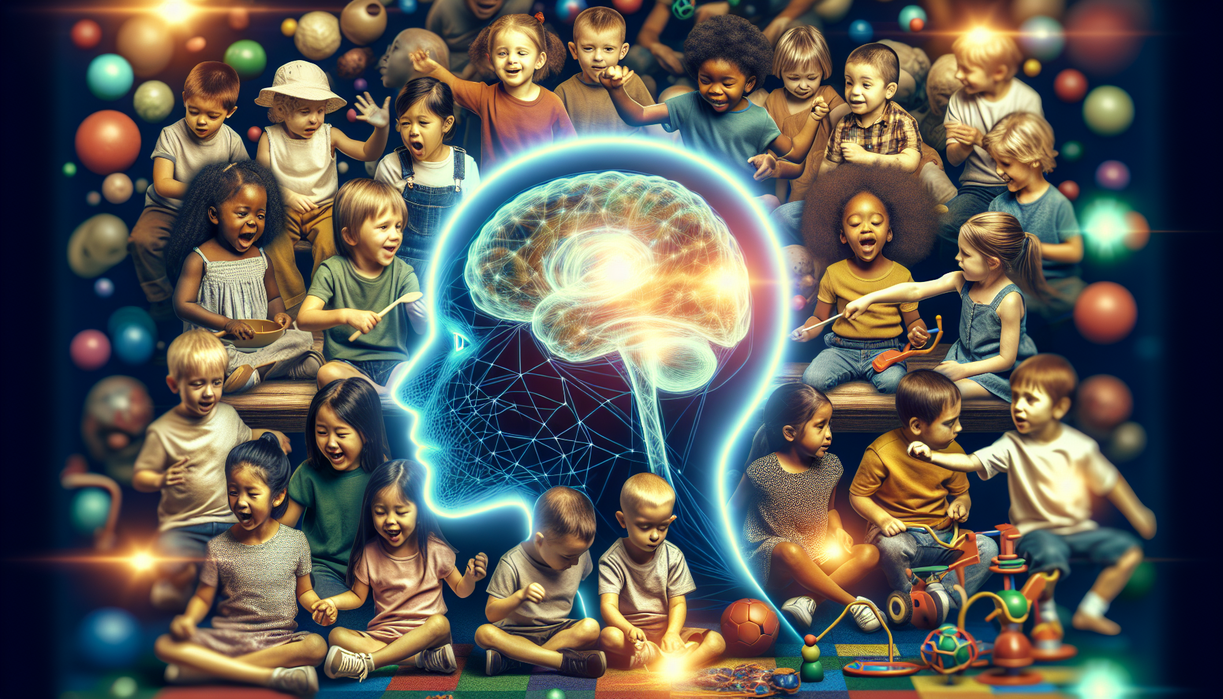
www.socioadvocacy.com – Neuroscience is quietly rewriting how we understand children at play. What once looked like simple fun now appears as a powerful workout for young brains, especially for regions tied to emotion, attention, and social skills. New research compares solo games with social play, showing clear links between preferred play style, social confidence, and patterns of brain activity. For parents, teachers, and caregivers, these insights turn everyday playtime into a window on development rather than a random burst of energy.
Instead of treating play as a break from learning, neuroscience suggests it may be the engine behind some of childhood’s most important lessons. Different kinds of play appear to tune different brain networks, shaping how children read faces, respond to peers, and regulate feelings. As we look closer at the data, a richer story emerges: the way children choose to play today may forecast how they connect, cooperate, and cope tomorrow.
What Neuroscience Reveals About Kids at Play
Recent neuroscience studies use brain imaging tools to track how young brains respond to various play settings. When children engage in social play, regions linked to empathy, reward, and self-control tend to light up together. Solo play, meanwhile, can activate systems responsible for imagination, focused attention, and problem solving. Neither mode is universally “better”; each appears to sculpt distinct pathways that support different strengths.
Researchers observe that children who spend more time in collaborative games often show stronger skills in turn-taking, perspective taking, and conflict resolution. Their brains display more synchronized activity between areas involved in reading social cues and regulating impulses. Solo-focused children sometimes excel at sustained attention, independent thought, and creative scenarios. Their neural patterns highlight deeper engagement in networks behind internal storytelling and planning.
From a neuroscience perspective, the key factor is not just the presence of play, but its variety. A childhood dominated only by one style can limit the full range of practice the brain receives. When kids move fluidly between solo exploration and shared adventures, they exercise both social circuits and introspective ones. That flexible switching appears crucial for navigating a world that demands cooperation, yet still rewards independent thinking.
Solo Play: A Quiet Lab for the Developing Brain
Solo play often gets misread as isolation or shyness, yet neuroscience paints a more nuanced picture. During solitary building, drawing, or imaginative scenarios, children test ideas without external pressure. Brain scans suggest stronger activation in networks related to internal attention, memory retrieval, and mental simulation. These systems help kids rehearse possible futures, experiment with roles, and process emotions privately.
Internally driven play also trains persistence. When a tower collapses or a puzzle resists solution, there is no friend to distract or rescue. The brain must manage frustration, recalibrate plans, and try again. Repeated cycles like this strengthen connections tied to self-regulation and cognitive flexibility. Over time, those circuits support school tasks that demand focus, such as reading, writing, or complex problem solving.
My perspective as a commentator on neuroscience is simple: we undervalue quiet time. Adults often rush to “socialize” every moment, worried that solo play signals a problem. Yet many innovators describe long childhood hours spent building worlds alone. Of course, persistent withdrawal deserves attention. Still, a healthy portion of solitary creativity can function as a training ground for original thought, emotional processing, and deep concentration.
Social Play: A Live Workout for Social Brains
Social play serves as the brain’s live-fire exercise for relationships. Neuroscience findings show that during group games, pretend scenarios, or rough-and-tumble fun, children constantly read faces, track shifting rules, and adjust behavior. Circuits associated with empathy, reward, and cognitive control must collaborate at high speed. Disputes over toys test negotiation skills; shared laughter strengthens bonds. As I see it, every playground argument or shared secret becomes mini practice for adult collaboration, leadership, and friendship. Healthy development rarely comes from solo or social experiences alone; instead, the richest outcomes appear when children receive room for both inner exploration and lively connection.
How Play Styles Shape Social Skills Over Time
Neuroscience does not claim a rigid destiny from play style, yet patterns emerge. Children who lean heavily toward social play often become adept at reading group dynamics. They notice subtle cues, pick up on jokes faster, and adjust speech or gestures to fit a situation. Brain networks behind face processing, emotion recognition, and reward expectation practice these micro-skills repeatedly during every shared game.
By contrast, children drawn to solo play sometimes show deeper comfort with sustained tasks and individual projects. Their social skills might develop more slowly or selectively, but they may outpace peers on independent assignments. When educators see this, the temptation is to label one path as superior. Neuroscience warns against quick judgments, since both trajectories provide valuable strengths for different environments.
The crucial factor is exposure rather than forced personality change. A socially bold child still benefits from quiet projects that require patience and reflection. A solitary thinker gains from low-pressure group experiences where curiosity outweighs performance. When adults curate a mix of contexts, the brain’s social circuits receive practice without crushing the child’s natural temperament.
What Parents and Teachers Can Do with This Science
Neuroscience becomes powerful only when it shapes daily practice. For caregivers, one step involves watching not only how long children play, but how they play. Do they gravitate to others immediately, or build a quiet corner first? Do their faces light up during group stories, or when constructing intricate solo projects? Those preferences offer clues to emerging strengths and potential gaps.
Instead of pushing a child away from preferred play, adults can gently widen the range. A socially fearless child might receive a solo art challenge before recess. A quiet builder may get invited into a small, predictable group game with clear rules. In classrooms, rotating stations that include cooperative challenges plus independent tasks help every child exercise a full spectrum of brain networks.
My view is that labels like “introvert” or “extrovert” often oversimplify what neuroscience reveals. Children are not fixed types; they hold shifting profiles of sensitivity, curiosity, and resilience. When play environments flex with those profiles, instead of fighting them, kids show better engagement and less stress. Over years, those small adjustments accumulate into stronger academic performance, richer friendships, and more confident self-understanding.
Play, Screens, and the Modern Brain
No conversation about neuroscience and play feels complete without digital life. Screen-based games can involve both solo focus and online social interaction, yet their signals differ from face-to-face play. Fast rewards, instant resets, and limited body movement create a narrower training ground for the brain. I do not see screens as enemies, but as tools requiring balance. Rich, real-world play floods the brain with complex sensory data, subtle emotional cues, and open-ended problems. Thoughtful limits on digital time preserve space for that richer workout, so children’s social brains grow through genuine eye contact, shared laughter, awkward pauses, and all the messy magic of real connection.
A Reflective Look at Play Through a Neuroscience Lens
As research deepens, a consistent theme emerges: play is not a luxury or a reward after “real” learning; it is a primary driver of neural growth. Neuroscience turns the sandbox, the living room floor, and the schoolyard into laboratories for social and emotional development. Solo play trains inner worlds; social play refines outer relationships. Whenever adults restrict play to squeeze in more formal instruction, they risk starving the very systems that support academic success.
From my perspective, the most hopeful message lies in the brain’s plasticity. Children who start with limited social practice can still flourish when given more diverse play opportunities. Those who cling to group activities can still discover the power of quiet reflection. There is no single perfect ratio; there is only ongoing tuning, guided by observation, empathy, and willingness to adjust environments over time.
Ultimately, neuroscience invites us to treat play as serious business, without stripping away joy. Instead of asking, “Is my child playing enough?” we might ask, “Do they experience many kinds of play?” The answer shapes not only skills for school, but capacities for love, collaboration, creativity, and resilience. When we protect and enrich play, we do more than entertain children. We help craft the social minds they will carry through the rest of their lives.