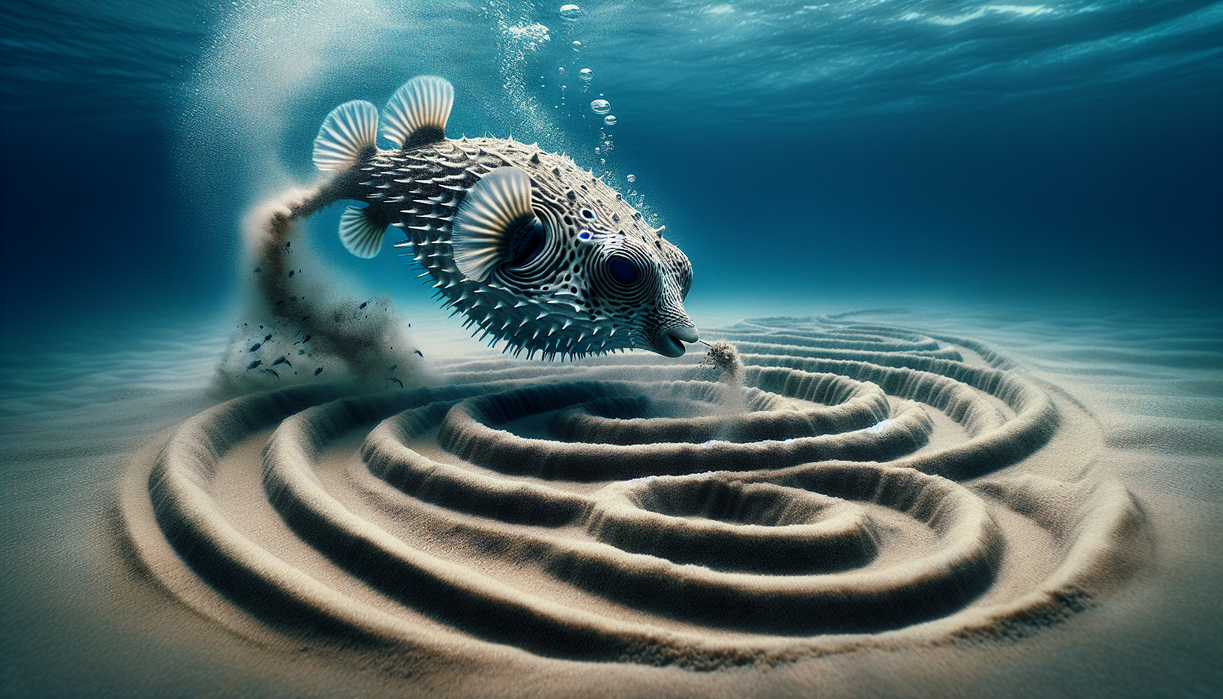
www.socioadvocacy.com – Far below the surface near Japan’s Amami Oshima Island, an artist works in secret. He has no hands, no tools, no studio, yet leaves behind sculptures so precise they stunned divers for years. These masterpieces are known as pufferfish sand circles, delicate rings carved into the seabed like underwater mandalas.
First spotted during the mid-1990s, the pufferfish sand circles appeared almost overnight. Each pattern looked deliberate, almost engineered, yet no one knew the maker. Only decades later did researchers uncover the truth: a small, unassuming male pufferfish, driven by courtship, crafts these elaborate geometric displays to lure a mate.
The mystery of Japan’s underwater crop circles
When divers first reported these patterns near Amami Oshima, comparisons to crop circles on farmland came quickly. Perfect rings radiated across the sandy seafloor, lined with grooves, ridges, small peaks. Their symmetry suggested intent, even planning. For a time, speculation ran wild. Could currents shape them? Were they traces of some unknown creature? Or simply a trick of light over rippled sand?
Detailed photography revealed startling detail. Each circle measured roughly two meters across, bordered by raised ridges and adorned with a crisp, almost lace-like center. Fine grains gathered strategically in the middle, rougher particles at the outer edge. Nothing looked random. Every curve seemed to follow a hidden blueprint, almost like a living compass had swept through the sediment.
Eventually underwater cameras captured the sculptor at work: a small, newly identified pufferfish species. The male spent days painstakingly sweeping his fins through loose sediment, nudging shells into position, correcting imperfections. His reward was simple yet vital. A visiting female would examine his pufferfish sand circles, judge his effort, then decide if he deserved the chance to pass on his genes.
How tiny fish become master sand engineers
The creation process turns the male into a tireless worker. He flutters close to the seabed, using his fins like brushes. Each sweep pushes sand outward, forming alternating valleys, ridges, then a circular central zone. Despite his modest size, he can sculpt a ring far larger than his own body. Precision emerges through repetition. He passes over the same lines again and again until the pattern stabilizes.
Hydrodynamics plays a crucial role. These pufferfish sand circles are not only visual displays. Their shape helps manage water flow above the eggs later on. Raised ridges disrupt strong currents, while the smoother center provides a calm pocket. That subtle engineering keeps eggs from being buried or swept away. It also channels finer particles toward the middle, creating an ideal nest bed.
What fascinates me most is the way instinct appears to encode geometry. The fish never attend any school, yet the design obeys rules reminiscent of human art, even architecture. Repetition, symmetry, contrast between rough edges and a refined core — these are principles designers learn consciously. The pufferfish applies them unconsciously, driven by selection pressure over countless generations.
Why pufferfish sand circles matter for science and imagination
Pufferfish sand circles highlight how even small creatures can shape their environment with surprising complexity. They challenge our sense of human uniqueness, especially regarding art, architecture, or design. Observing a tiny fish draw a two-meter ring for love forces a humbler view of creativity itself. For scientists, these circles offer a window onto sexual selection, hydrodynamics, and behavioral evolution. For storytellers or dreamers, they serve as proof that the ocean hides galleries we barely know exist. Next time we speak of intelligence or beauty, we should remember the little pufferfish, etching silent love letters into sand where light rarely reaches, yet meaning runs deep.