www.socioadvocacy.com – Quantum physics reshaped our view of matter, energy, and information. General relativity rewrote our picture of gravity, space, plus time. Yet these two pillars of modern science still refuse to fit neatly inside one elegant frame. Researchers exploring quantum gravity in five dimensions hope to change that, offering a fresh way to unite the very small with the very large.
Instead of only tweaking equations, scientists now experiment with bold new geometries. Extra dimensions, holographic ideas, and strange curvatures of spacetime emerge from this search. Quantum physics becomes a guide through this maze, hinting at how gravity could arise from more fundamental quantum processes. Five-dimensional models may sound exotic, yet they reveal surprising insights about our familiar four-dimensional universe.
Why Quantum Physics Struggles With Gravity
Quantum physics excels at describing atoms, particles, and fields. Probabilities replace certainties, while energy levels appear as discrete steps. General relativity tells a different story. Mass and energy bend spacetime, then objects follow those curves. Each theory performs brilliantly in its own domain, yet their mathematical languages clash under extreme conditions.
At black hole centers, gravity becomes immense, distances shrink, and quantum effects can no longer be ignored. General relativity predicts singularities, regions where densities soar and equations break down. Quantum physics prefers smooth, finite quantities. Trying to quantize gravity with ordinary methods leads to infinities, plus equations that defy standard renormalization techniques.
Our universe also began in an ultra-dense state. Near the Big Bang, quantum fluctuations, violent expansion, and intense gravity all mattered together. To describe such moments, we need a consistent framework. Quantum gravity aims to build this, yet many paths compete. Loop quantum gravity, string theory, causal sets, emergent spacetime ideas all attempt to reconcile the two great theories without losing their successful predictions.
Five Dimensions: More Than Science Fiction
Extra dimensions first appeared in physics long before science fiction popularized them. Early in the 20th century, Kaluza and Klein explored a five-dimensional model, hoping to merge gravity with electromagnetism. Later, string theory revived higher dimensions as a necessity rather than a curiosity. Quantum physics, when combined with vibrating strings, seems to prefer more than four dimensions for mathematical consistency.
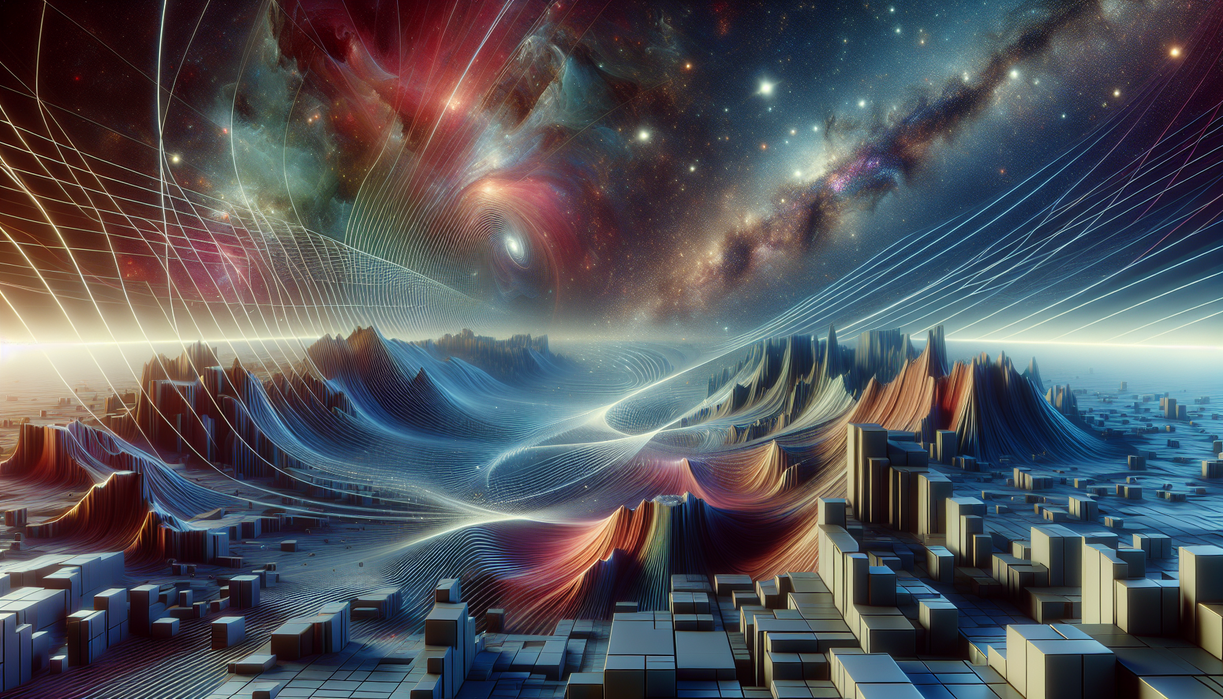
In a five-dimensional setting, our familiar three dimensions of space plus one of time sit inside a larger structure. The extra dimension may be compactified, tightly curled up, or extended yet hidden. Gravity can travel through this larger arena, while ordinary particles stay mostly confined to a four-dimensional “brane”. This idea allows gravity to look weak to us, because some of its influence spreads into the extra dimension.
Personally, I find five-dimensional models helpful as conceptual laboratories. They free us from habits tied to everyday space, while still remaining mathematically manageable. We can test how quantum physics behaves when spacetime gains an extra degree of freedom. We also see how curvature, information flow, and even black hole properties change once an additional direction becomes available.
Quantum Physics, Holography, and Emergent Spacetime
Perhaps the most intriguing role for quantum physics in five dimensions arises through holographic dualities. In some models, a gravitational theory in a five-dimensional bulk corresponds to a quantum field theory on a four-dimensional boundary, without gravity there. Geometry on the inside mirrors quantum information on the edge. From my perspective, this suggests spacetime might not be fundamental at all. Instead, it could emerge from deep patterns of quantum entanglement. Five-dimensional gravity then becomes a powerful visualization tool, translating abstract quantum relations into curved shapes. Exploring these ideas further may eventually reveal why space, time, and gravity feel so real, even if they arise from something more subtle underneath.
What Five-Dimensional Gravity Teaches Us
Five-dimensional models highlight how gravity can behave very differently from our expectations. Black holes, for example, gain new possible shapes. Instead of only spherical horizons, we can see ring-like structures or more exotic configurations. These solutions test ideas about stability, entropy, and the flow of information. Quantum physics provides tools to estimate how such objects radiate, interact, or evolve over time.
These higher-dimensional scenarios also clarify how energy and information spread through spacetime. Certain puzzles, including the black hole information paradox, become easier to analyze via five-dimensional setups paired with holographic reasoning. Quantum physics on a boundary theory encodes detailed data about processes deep in the bulk. That link allows physicists to translate seemingly impossible gravitational questions into better-understood quantum field problems.
Personally, I view these five-dimensional exercises as thought experiments turned into rigorous mathematics. They may not describe our universe directly, yet they sharpen our intuition. When patterns repeat across dimensions, we gain confidence that some features of quantum gravity do not depend on chosen details. Five-dimensional frameworks then act as training grounds, preparing us for eventual theories that might apply exactly to our four-dimensional cosmos.
Branes, Bulk, and the Role of Quantum Physics
Modern approaches often picture our universe as a brane, floating in a higher-dimensional bulk. Ordinary matter and forces stay tied to the brane, while gravity extends into the bulk. Quantum physics determines how fields fluctuate on that brane, plus how they couple to bulk geometry. This picture has led to creative cosmological models, including scenarios where collisions between branes trigger events resembling a Big Bang.
Such constructions also explore how quantum corrections might modify gravity at very small or very large scales. Deviations from familiar gravitational behavior could arise if the extra dimension has unusual geometry or size. Experiments search for tiny departures from Newton’s law at short distances, hoping to catch hints of hidden dimensions. So far, no clear signal has appeared, yet the window remains open.
My own sense is that brane-world ideas showcase quantum physics as a sculptor of reality rather than a passive descriptor. Fluctuations on the brane shape the bulk, while bulk curvature influences quantum fields in return. This interplay goes beyond simple cause and effect. It feels more like mutual co-creation, where geometry and quantum states continually redefine each other.
Are Five Dimensions Real or Just a Powerful Metaphor?
Whether extra dimensions truly exist or serve mainly as conceptual scaffolding, their value to quantum physics remains significant. Five-dimensional models let us probe deep questions about gravity, information, and the origin of spacetime structure. From my perspective, they remind us that reality may be stranger than any single theory can capture today. Even if future observations favor different explanations, the mathematical journeys through higher dimensions will have refined our tools and sharpened our questions. Reflecting on this, I suspect the real breakthrough will not be a single equation, but a new way of thinking about space, time, and quantum processes as aspects of one underlying story.
Looking Ahead: Quantum Physics Beyond Four Dimensions
Research on five-dimensional quantum gravity feels both ambitious and humble. Ambitious, because it aims to merge the deepest theories we possess. Humble, because every model carries assumptions, approximations, and open issues. Quantum physics continues to surprise us, often overturning earlier intuitions. Higher-dimensional gravity adds another layer of challenge, yet also a rich supply of conceptual tools.
Future progress will likely come from a blend of approaches. Improved numerical simulations, new mathematical frameworks, plus unexpected experimental clues could all play key roles. Subtle signatures in gravitational waves, cosmological background patterns, or tiny deviations from standard gravity might point toward or away from higher dimensions. Each result will help narrow the field of viable ideas.
For now, I see five-dimensional thinking as a training ground for imagination anchored by rigorous quantum physics. It pushes us to question familiar assumptions about what space and time must be. It also urges us to consider information, entanglement, and geometry as intertwined facets of a single underlying reality. As we continue this exploration, the most valuable outcome may be the mindset it cultivates: curious, flexible, and prepared to accept that the universe could be far richer than the four-dimensional world we observe each day.