www.socioadvocacy.com – Space exploration usually calls to mind rockets, rovers, and gleaming telescopes, yet some of the most powerful discoveries hide inside tiny crystals dug from ancient rocks. Recent research on 3.7‑billion‑year‑old minerals from Australia, paired with Apollo lunar samples, offers a fresh story about how Earth and the Moon emerged from cosmic chaos. Instead of separate tales, the two worlds now appear as chapters from one violent origin event.
This new picture suggests Earth’s continents arrived surprisingly late, long after a colossal impact forged the Moon. For space exploration, the study is a reminder that we do not always need to fly farther to learn more. Sometimes, the key lies in revisiting dusty samples from past missions, then linking them with overlooked evidence preserved beneath our feet.
Ancient rocks as guides for modern space exploration
The Australian crystals at the center of this research formed more than three billion years ago, during Earth’s early youth. They survived tectonic recycling, volcanic burial, and endless erosion. Each grain acts as a geological time capsule, preserving clues about heat, chemistry, and water on the infant planet. When scientists studied their composition, they found hints that Earth’s continents solidified later than many previous models proposed.
Space exploration usually points outward, yet this work depends on a partnership between deep‑time geology and lunar science. The same isotope tools used to decode Martian meteorites now help date the formation of Earth’s earliest crust. By comparing age signatures, researchers noticed a striking parallel between these Australian minerals and rocks brought back by Apollo astronauts decades ago.
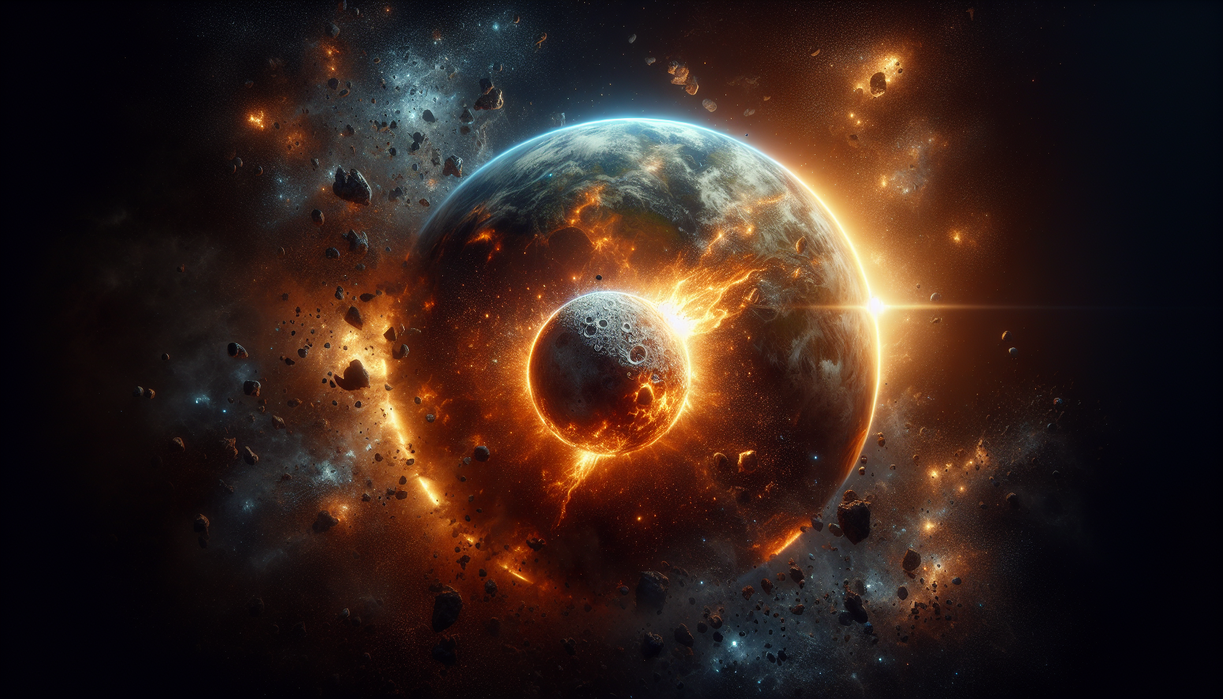
The Moon samples show a narrow cluster of ages, consistent with formation after a single tremendous collision between early Earth and a Mars‑sized body often called Theia. According to the study, Earth’s continental crust grew substantially only after this impact. So, Earth and Moon share a linked timeline. Our planet’s solid surface, the continents we stand on, seems to be part of the long recovery from that catastrophic event.
What the Moon’s scars reveal about our own planet
The Moon behaves like a museum for early solar system events. With no plate tectonics, almost no atmosphere, and very little erosion, its surface preserves scars from an era Earth largely erased. Space exploration missions to the Moon, especially Apollo, collected rocks that retain a geochemical record of intense melting. Those samples help scientists estimate when the lunar crust first solidified after the giant impact.
By matching the ages of lunar rocks with the ages of Earth’s oldest crystals, researchers can test models of how both bodies cooled. The new comparison hints that Earth remained a seething magma ocean for longer than once imagined. Stable continents did not appear immediately after the impact. Instead, they developed gradually as heat escaped into space, while fragments from the collision coalesced nearby to become the Moon.
For me, the most striking lesson comes from this synergy between lunar geology and terrestrial evidence. Space exploration, at its best, dissolves boundaries between worlds. Data from a place hundreds of thousands of kilometers away helps answer questions about our own origin story. Meanwhile, crustal fragments from a remote corner of Australia assist with decoding the Moon’s infancy. Planetary science becomes a single conversation across two very different landscapes.
Why late continents matter for life and space exploration
Delayed continental growth has major implications for the history of life. Continents influence climate, ocean chemistry, and nutrient cycles. If they formed later, early life likely evolved on a more ocean‑dominated world, with fewer stable landmasses. That changes how we imagine the first ecosystems. Shallow coastal zones, mineral‑rich rivers, and weathered rocks may have arrived as a second act rather than a starting point.
This revised timeline also reshapes our approach to space exploration beyond Earth. When we search for habitable exoplanets, we often look for worlds with surface water and some form of plate tectonics. If continental growth tends to follow a giant impact stage, then planets with large moons might be especially promising. A moon can help stabilize a planet’s tilt, soften climate swings, and possibly influence long‑term geological evolution.
Personally, I see this as a nudge to widen our checklist for life‑friendly worlds. Instead of only asking, “Is it in the habitable zone?” we might ask, “Did it endure a major collision, then recover with a stable crust and maybe a sizable moon?” Space exploration, particularly future lunar and exoplanet missions, could test this idea. The more we learn about our own origin, the better we can recognize familiar patterns across the galaxy.
Re‑reading Apollo samples through a modern lens
A compelling side story here involves the Apollo program. Astronauts gathered lunar rocks half a century ago, yet their full significance keeps growing as new techniques emerge. Space exploration often appears driven by novelty, but this work proves old samples stay valuable. Advanced isotope measurements, more precise than anything available during the Apollo era, allow scientists to revisit those rocks with sharper eyes.
When researchers compared the lunar ages with dates from Australian crystals, they identified overlapping periods of intense crust formation. This overlap strengthens the case for a single giant impact event rather than multiple smaller ones. It also supports models where debris from the collision rapidly formed the Moon, while Earth’s surface slowly transitioned from molten chaos to a stable, differentiated crust.
From my perspective, this highlights an underrated aspect of space exploration: good archiving. The wisdom to store, catalog, and protect samples for future generations may be as important as launching the missions themselves. Some Apollo material remains sealed for exactly this reason. Our tools grow more sensitive over time, so each decade lets us extract new stories from the same dusty fragments.
How this shapes future missions and questions
The connection between Earth’s early crust and lunar history will likely guide upcoming missions. NASA’s Artemis program aims to return humans to the Moon, with a stronger emphasis on science and resource mapping. Future crews may target regions suspected to hold ancient crust or impact‑melt deposits. Those areas could refine our understanding of the giant impact timeline, while also revealing materials useful for sustainable lunar bases.
Beyond the Moon, Mars and some large asteroids might tell parallel stories. If giant impacts are common during planet formation, other worlds should preserve their own versions of these scars. Space exploration missions focused on sample return, from Mars or even from asteroid belts, could reveal whether late crust growth is a universal stage or a quirk of Earth’s history.
I suspect these questions will steer planetary science for decades. Do habitable planets usually need a violent beginning? How often does a collision yield a stable moon rather than catastrophe? Will we find exoplanetary systems where large moons appear as beacons of past impacts? To me, these puzzles make the universe feel both harsher and more welcoming. Destruction and creation turn out to be closely linked.
A shared origin story across the solar system
Stepping back, the story of 3.7‑billion‑year‑old Australian rocks and Apollo lunar samples reads almost like family history. Earth and Moon, once viewed as separate characters, now appear as siblings born from the same traumatic event. Space exploration has given us the tools to piece together this origin, not only through distant probes but also through careful work with grains of ancient crust. For me, the most reflective takeaway is that our world emerged from violence yet evolved toward stability, oceans, continents, and eventually life capable of asking how it all began. Understanding that journey does more than satisfy curiosity; it shapes how we search for other places where chaos may have quietly given rise to complexity beyond our own sky.