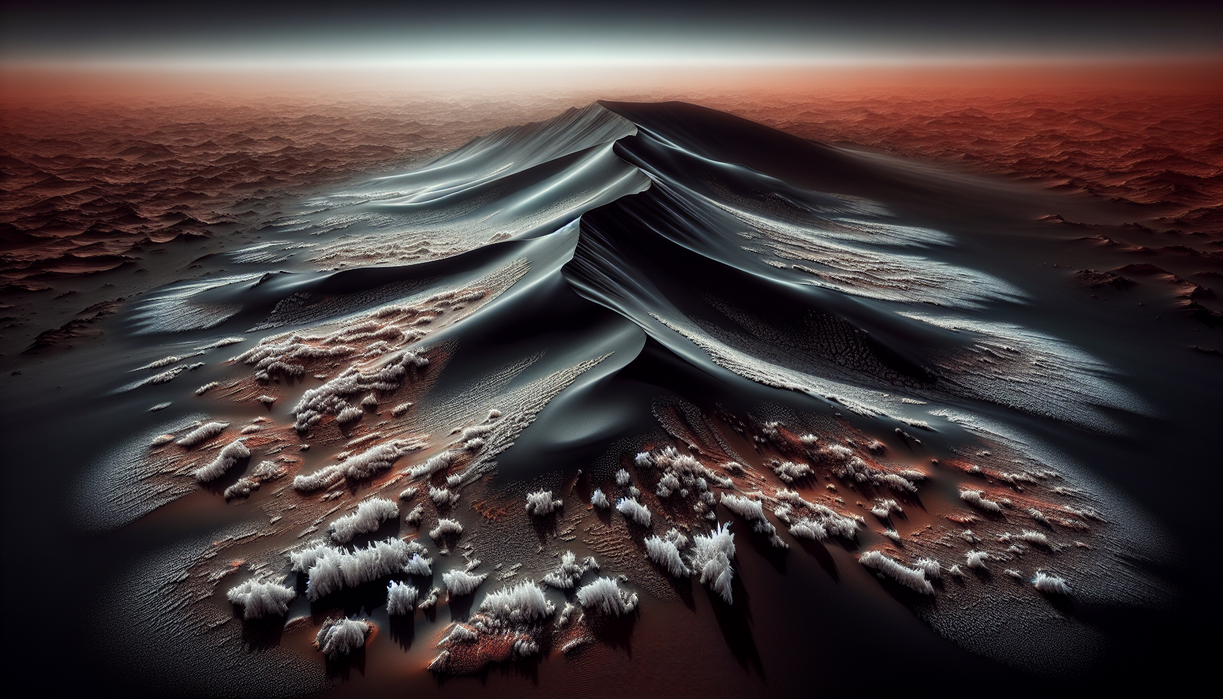
www.socioadvocacy.com – Kaiser crater on Mars offers a stunning seasonal show, where frosted dunes slowly awaken under the rising spring sun. Each year, this impact basin near the Martian equator shifts from a bright, icy landscape into a patchwork of exposed dark sand and glittering ice. For planetary scientists, Kaiser crater serves as a natural laboratory for watching an alien winter loosen its grip.
The most dramatic change appears on a dark dune buried beneath a thin shell of winter frost. As spring advances, the dune’s western slope begins to warm first, shedding ice faster than the rest of the surface. The result is a striking contrast: rich, dark sand reveals itself amid lingering patches of water ice and carbon dioxide frost, hinting at active processes reshaping Kaiser crater even today.
Seasonal Frost Cycles in Kaiser Crater
To understand what happens in Kaiser crater, it helps to picture Mars as a desert world with an extreme winter coat. During the cold season, carbon dioxide from the thin atmosphere freezes directly onto the ground, forming a translucent layer across dunes and rocks. Water ice can join this layer, especially in shaded spots or higher elevations, turning the crater into a pale, frosted bowl when winter peaks.
When sunlight returns in Martian spring, that frozen carbon dioxide does not simply melt like snow on Earth. Instead, it can sublimate, skipping the liquid phase entirely. Gas builds up beneath the frost and escapes through weak points, sometimes blasting sand upward in small jets. Over Kaiser crater’s dunes, this process can carve subtle patterns, leaving streaks and spots across the dark surfaces that only appear once the ice retreats.
The western slope of the featured dune in Kaiser crater thaws earlier because of how sunlight hits the terrain. Slight differences in angle, elevation, and surface texture influence how much energy reaches the ice. As that slope warms faster, frost thins from the top down, exposing dark grains long before other areas. This staggered thaw lets researchers observe multiple stages of the seasonal cycle at once, all contained within a single dune face.
Water Ice, Carbon Dioxide Frost, and Alien Weather
Two main types of ice shape the appearance of Kaiser crater through the year: water ice and carbon dioxide frost. Water ice forms a more persistent reservoir, often locked in pores or shaded crevices. Carbon dioxide, which dominates the Martian atmosphere, cycles rapidly between gas and solid as temperatures change. Viewed from orbit, this combination creates complex patchwork patterns that shift from white to gray to deep brown.
In Kaiser crater, lingering blotches of bright material during spring reveal where ice still clings to shadowed surfaces. Those icy remnants contrast sharply with the newly exposed dune sand, highlighting edges and ridges that were nearly invisible under a winter blanket. Such mosaics do more than satisfy curiosity; they help scientists decode how local weather behaves, from temperature swings to subtle wind flows along crater walls.
As an observer, I find this interplay between water ice and dry ice in Kaiser crater especially revealing. It suggests Mars is not a frozen relic, but a landscape with ongoing activity on seasonal and even daily timescales. When the dune’s western slope frees itself from winter faster than nearby terrain, it offers a window into how small differences in sunlight and surface properties can produce large visual changes across the crater floor.
What Kaiser Crater Reveals About Mars’ Active Surface
Watching Kaiser crater evolve from winter frost to spring thaw changes how we think about Mars as a whole. These shifting dunes, venting gases, and alternating layers of water ice and carbon dioxide frost speak to a world where climate and surface constantly interact, even without rivers or rain. For future explorers, Kaiser crater may serve as a case study in reading seasonal markers on an alien planet. More personally, it reminds me that even in a harsh, distant environment, cycles of rest and renewal persist. The dark dune emerging from its icy shell feels like a quiet assurance that change, though slow and subtle, continues to sculpt Mars year after year.