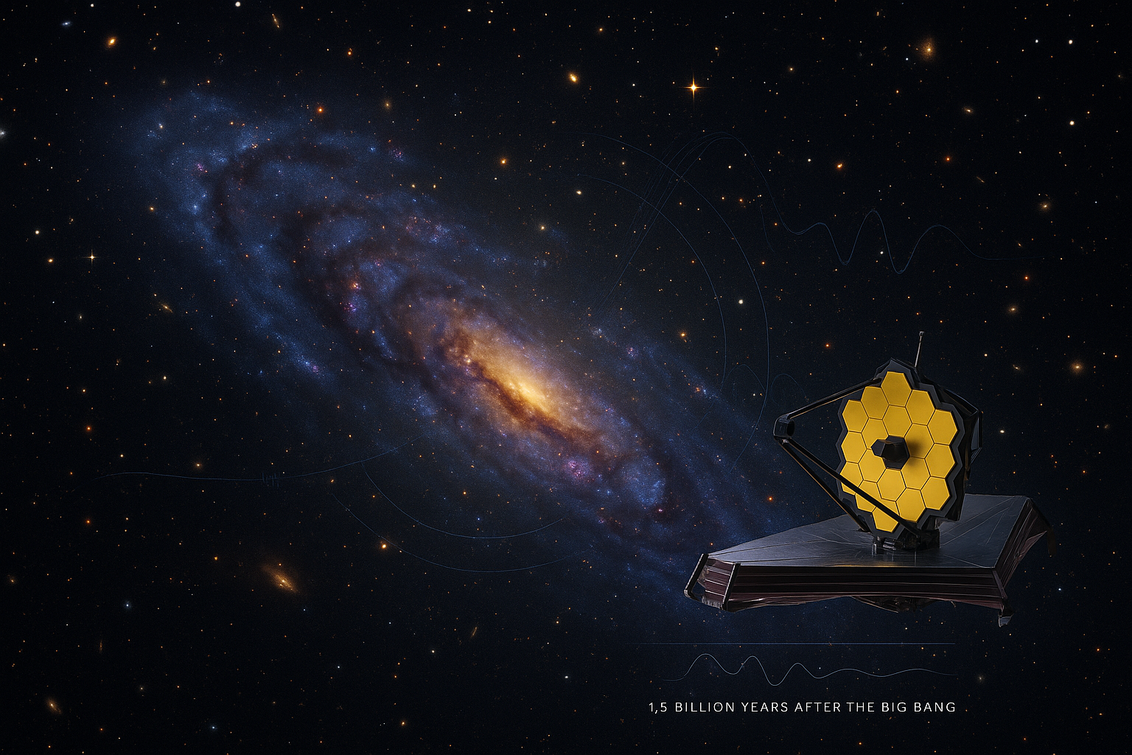
www.socioadvocacy.com – In recent science news, an early-universe galaxy has stunned astronomers by breaking what many thought were ironclad rules of cosmic evolution. Using the James Webb Space Telescope (JWST), researchers spotted a striking stellar bar inside galaxy GN20, seen as it existed just 1.5 billion years after the Big Bang. That feature should not be there so soon, at least according to standard models that describe how galaxies grow and mature.
This unexpected structure has quickly become one of the most talked‑about topics in current science news because it suggests that large, organized patterns in galaxies can arise far earlier than expected. If confirmed, this finding forces scientists to rethink how stars assemble, how gas flows shape galaxies, and even how supermassive black holes feed in the young universe.
A stellar bar that should not exist
Galaxy GN20 already held a place in science news as a massive, dusty star‑forming system in the distant cosmos. What JWST revealed now goes a step further: across its bright central region stretches a long bar of stars, reminiscent of the bar seen in our own Milky Way. Bars concentrate stars and gas into an elongated structure cutting through a galaxy’s center, guiding material inward and sculpting spiral arms.
Bars usually appear in mature disk galaxies, not in turbulent youngsters only 1.5 billion years after the Big Bang. Conventional simulations predict that early galaxies at that epoch should be chaotic, thick, and clumpy, still settling into stable disks. For a bar to develop, the underlying disk needs to be relatively ordered, with well‑defined orbits that can support this elongated shape across hundreds or even thousands of light‑years.
Yet JWST’s infrared vision clearly suggests GN20 hosts such a bar. That means its disk must have formed fast, then stabilized quickly enough for gravitational instabilities to carve out the bar. To me, this is like walking into a nursery and finding a fully grown oak with sprawling branches; the timescale feels all wrong, which hints that our growth timeline needs serious adjustment.
Why this science news shakes galaxy formation theory
Bars play a crucial role in galactic ecosystems. They act like interstellar conveyor belts, dragging gas from outer regions toward the center. This inflow can ignite intense starbursts near the core and feed central black holes. When such a mechanism appears extremely early, it implies galaxies may be far more efficient at re‑shaping themselves than our models allow. GN20’s bar could be jump‑starting central star formation and black hole growth much sooner than expected.
Current simulations usually show bars forming several billion years after the Big Bang, once disks calm down and grow in mass. Finding one just 1.5 billion years out suggests either that GN20 is an extreme outlier, or that our theoretical framework lacks key physics. Perhaps gas cools faster, turbulence decays more efficiently, or dark matter halos stabilize disks more quickly than we assumed. Each possibility prompts new lines of research and fresh simulation campaigns.
As I see it, the power of this science news lies in how it exposes the gap between prediction and observation. When a single object violates our expectations so dramatically, scientists face a productive choice: tweak existing models at the margins or embrace a deeper revision. GN20 might be a rare curiosity, but history shows that anomalies often end up driving major breakthroughs in understanding.
What JWST is really telling us about the young universe
Looking beyond this one galaxy, GN20’s bar reinforces a broader message from JWST: the early universe appears more structured, massive, and mature than many forecasts suggested. We have already seen surprisingly bright early galaxies, unexpectedly heavy black holes, and intricate chemical fingerprints just a few hundred million years after the Big Bang. Now, a prominent bar only 1.5 billion years in challenges the narrative of slow, gradual assembly. From my perspective, the lesson is not that our entire cosmological picture is wrong, but that the pathways from simple initial conditions to complex galaxies can be more direct, more rapid, and more creative than our equations have captured so far. This science news invites us to refine models, expand simulations, and embrace a cosmos that may organize itself with remarkable speed.