www.socioadvocacy.com – Space looks calm from a distance, yet navigation there can turn into a nightmare. GPS does not work beyond Earth’s comforting shell, radio signals crawl slowly across vast emptiness, plus tiny errors grow into huge deviations. NASA recently faced this harsh reality when some orbital robots began to drift off their intended paths, proving Earth-based guidance strategies cannot simply be copy-pasted into space.
To solve this, NASA’s engineers turned to an idea borrowed from industry: digital twins. These hyper-detailed virtual replicas mirror each robot’s hardware, software, and environment through data. By pairing physical space robots with simulated counterparts, controllers discovered a way to rehearse each move before committing to it. The result: robots that stay on track, even when space tries to push them off course.
Space navigation’s invisible problem
Traditional navigation depends heavily on tools rooted near Earth. GPS, ground radar, and dense tracking networks guide planes, ships, and satellites. Once spacecraft travel deeper into space, those support systems fade. Signals stretch over millions of kilometers, small timing slips grow large, and even accurate sensors struggle to keep up with changing forces. A robot can start perfectly aligned yet slowly wander off target.
Space also hides many subtle influences. Slight gravitational pulls from planets, solar pressure from streams of photons, and minute thrust irregularities combine to nudge vehicles away from planned orbits. On shorter flights those nudges may not matter; on longer missions, their effect becomes critical. Robots do not notice these shifts unless their models and sensors track them continuously with great precision.
NASA’s orbital robots, especially free-flying inspection or servicing units, rely heavily on autonomous control. Yet autonomy still needs trustworthy navigation data. Controllers discovered gaps between the robots’ internal estimates and their actual positions. Over time, those gaps led to drift. Instead of relying solely on more ground corrections, the team sought a solution able to live side by side with the hardware and predict trouble before it appeared.
How digital twins keep space robots on course
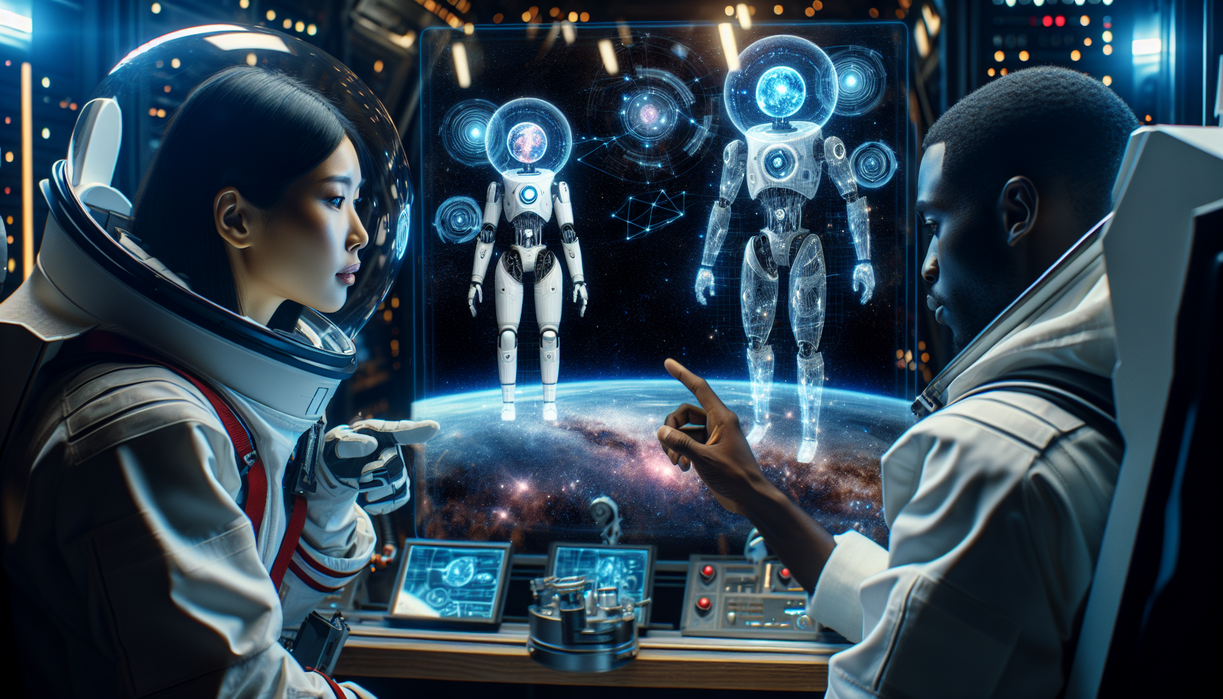
A digital twin is more than a simple 3D model. It behaves like a living simulation locked to real sensor inputs, commands, and environment data. For a space robot, the twin receives the same control signals as the physical unit. It also ingests streams from cameras, gyros, star trackers, and thrusters. Advanced algorithms then compare expected behavior to reality on a moment-by-moment basis.
When the real robot drifts, the twin notices first. If the twin’s simulated orbit begins to diverge from observations, the system flags hidden issues such as miscalibrated sensors, uneven thrust, or small unmodeled forces. NASA engineers can then test corrective actions on the twin. Only after a maneuver proves safe in the virtual environment do they send final commands to the space robot.
This closes an important feedback loop. Instead of waiting for large navigation errors, the digital twin catches small discrepancies early. It acts like a rehearsal stage for space operations where every move plays out twice. One scenario remains purely digital, so failure costs nothing. The other unfolds in orbit, guided by lessons extracted from its virtual partner. That partnership helps keep NASA’s robots close to their intended tracks, even during complex maneuvers.
Lessons for future space missions
From my perspective, digital twins mark a turning point for space exploration strategy. They allow engineers to treat each mission as a living experiment rather than a rigid sequence of preplanned steps. As future projects push toward lunar bases, asteroid mining, or crewed journeys to Mars, swarms of autonomous robots will handle inspection, maintenance, and construction far from Earth. Those machines cannot rely mainly on delayed human oversight. Virtual counterparts will help them adapt to dust, thermal swings, and unmodeled forces. Space will always remain harsh and unpredictable, yet pairing physical explorers with intelligent digital shadows can reduce risk, sharpen decisions, and keep humanity’s robotic pathfinders from getting lost out there.