www.socioadvocacy.com – Content context is often shaped by bold choices, not safe routines. Few stories prove this better than Voyager 1’s Pale Blue Dot photograph, a single frame that almost never existed. Near the edge of the Solar System, the spacecraft had finished its primary planetary tour. Mission controllers were ready to move on. Engineers feared that turning the camera back toward the Sun might fry sensitive optics. For them, the risk looked unnecessary. Yet for astronomer Carl Sagan, the potential content context of such an image outweighed the danger: a portrait of Earth as a tiny glimmer in a vast cosmic ocean.
That quiet argument at NASA did more than decide a camera command. It influenced how billions of people think about our place in the universe. By insisting on that backward glance, Sagan helped craft not just a picture, but a new narrative frame, a deeper content context for every conversation about Earth, science, even politics. This was not just space exploration; it was storytelling at interstellar scale. To understand why this single decision mattered so much, we need to look at what was at stake, who took the risk, and how the Pale Blue Dot still reshapes meaning today.
The photo that almost did not exist
Voyager 1 launched in 1977 with a clear job: inspect Jupiter and Saturn, then continue outward into interstellar space. Its cameras were built for flybys, not sentimental portraits. Once the planetary encounters ended, many team members saw little reason to keep using those instruments. The spacecraft had work to do monitoring fields, particles, and the invisible frontier beyond the giant planets. Pointing a camera back toward the inner Solar System looked more like a distraction than science.
Meanwhile, engineers had serious concerns. Turning the camera toward the Sun risked flooding the sensors with intense light. That could scar the optics or damage the electronics permanently. From a conservative engineering mindset, sacrificing any hardware for a symbolic image felt reckless. The mission had already delivered stunning views of Jupiter’s storms and Saturn’s rings. Why push equipment to the edge for a picture of Earth that, at that distance, would appear as a single dim pixel?
Carl Sagan saw the problem through another lens: content context. For him, Voyager 1 could do one final, unmatched act of communication. He argued that showing Earth as a tiny point of light suspended in darkness would reframe how humans think about themselves. The science team, managers, and engineers debated potential loss versus potential impact. In the end, they approved a carefully designed sequence. On February 14, 1990, Voyager 1 pivoted, snapped a family portrait of the Solar System, and captured Earth as that now legendary pale blue dot, cradled in scattered sunlight.
Content context: from data to meaning
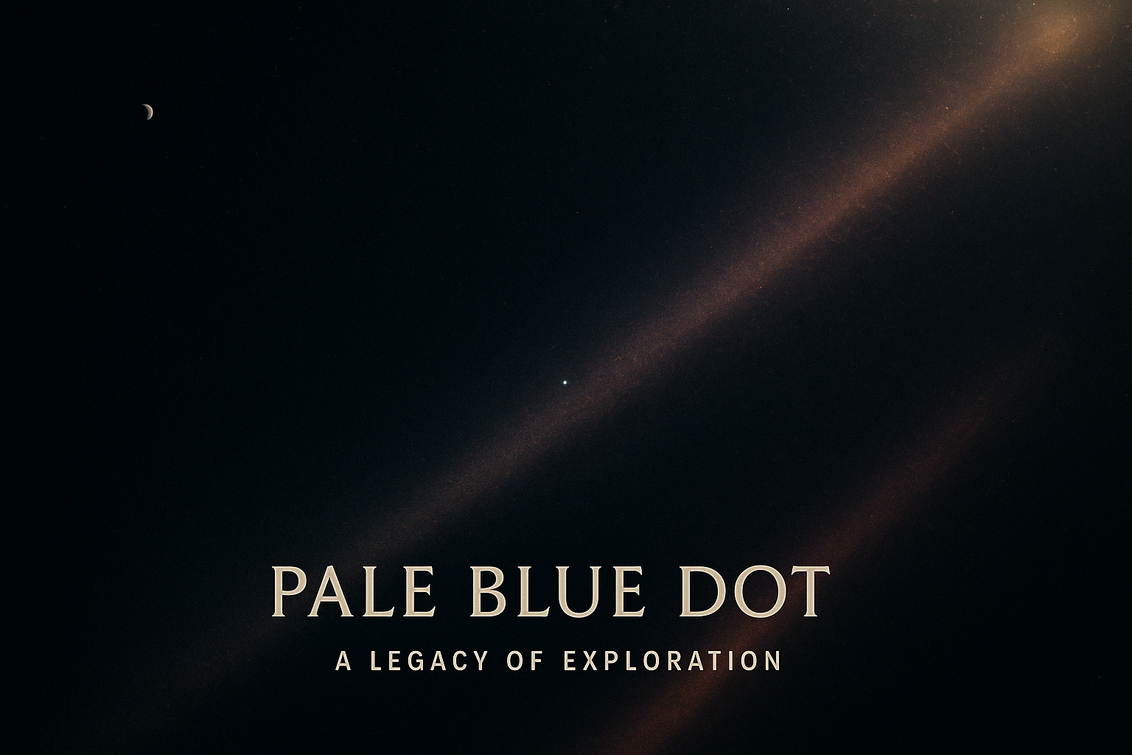
On its own, the Pale Blue Dot image is not visually impressive. No swirling clouds in sharp focus, no glowing auroras. Just a few colored streaks of light, caused by sunlight scattering through the camera optics, with a tiny blue speck tucked inside one band. Technically, many photographs from Hubble or the James Webb Space Telescope are far more beautiful. Yet almost none have matched this image’s influence on public imagination, proof that content context can matter more than raw aesthetics.
Sagan’s famous meditation on the Pale Blue Dot gave the picture emotional gravity. He described Earth as a stage for every joy, every war, every civilization. His essay attached story to pixel, connecting distant spacecraft telemetry to our daily lives. Here content context turned an obscure engineering success into a shared human mirror. Without that narrative layer, the image might have sat in an archive as a curiosity. With it, the photograph became a cultural landmark quoted in classrooms, documentaries, and political speeches.
This shift reveals something vital about science communication. Facts and images leave incomplete impressions until someone frames them. Context turns information into insight. Voyager 1’s picture carried scientific significance as a snapshot from the outer Solar System. Through thoughtful framing, it became a meditation on humility, responsibility, and unity. In that sense, the Pale Blue Dot marks one of the clearest examples of how content context can elevate data into enduring meaning that travels far beyond laboratories and mission control centers.
Risk, reward, and the stories we choose
Looking back, the decision to risk Voyager 1’s camera for a fragile sliver of light feels almost obvious, because we live with its consequences. Yet at the time, it demanded courage. Engineers defended hardware, scientists weighed trade‑offs, communicators imagined potential impact. The final outcome reminds us that exploration is not just about reaching new places but about deciding which stories to tell once we get there. By embracing a daring act for the sake of richer content context, NASA and Sagan left us a quiet, persistent question: when we hold powerful tools, do we use them only for safety and routine, or also to create visions that might reshape how future generations see their world? The Pale Blue Dot suggests that sometimes, turning the camera around is the most important mission of all.