www.socioadvocacy.com – Context often decides whether a scientific fact feels terrifying or simply fascinating. Take Earth’s magnetic field: headlines about its possible reversal can sound apocalyptic, yet a calmer context reveals a story of resilience, subtle risks, and dazzling skies. To understand what might happen next, we need to look at how this invisible shield behaves over millions of years, not just through a single news cycle.
Earth’s magnetic field, forged by swirling molten iron in the core, acts as a protective bubble against charged particles from the Sun. In this context, every recorded reversal over the last 83 million years has been part of a longer planetary rhythm. The shield weakens, flips, recharges, and life continues, though with temporary changes to radiation exposure and auroral displays.
Earth’s Magnetic Field in Context
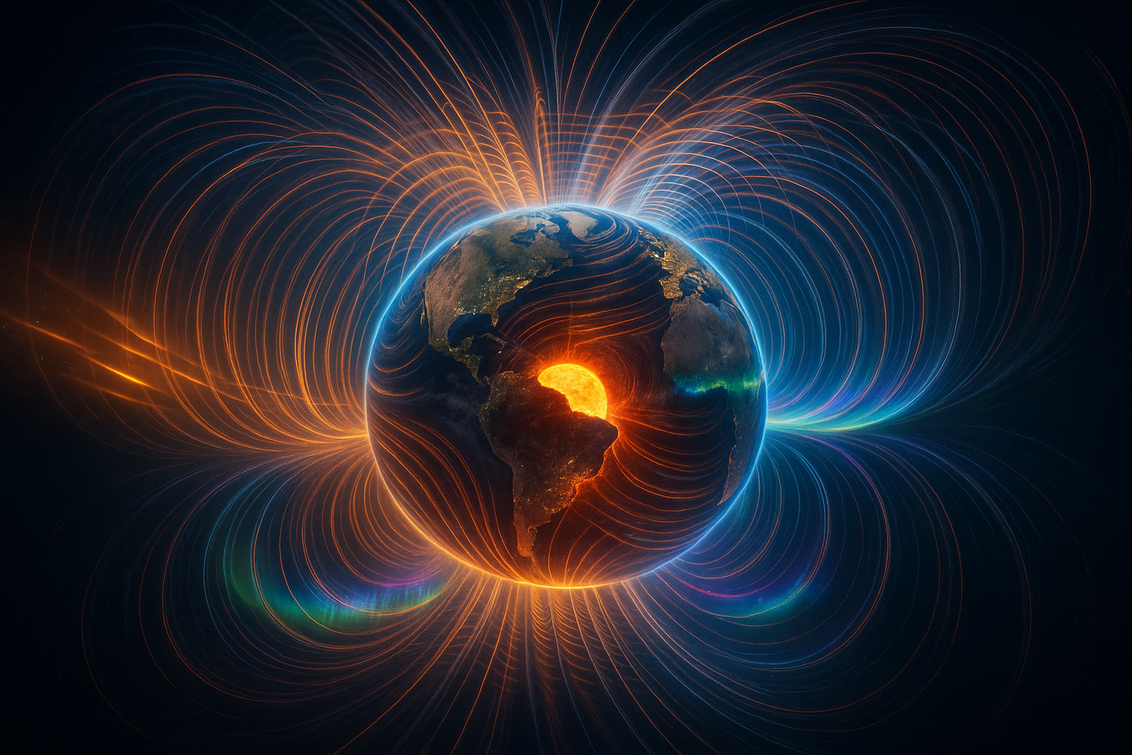
To grasp what a reversal means, we first need context for the magnetic field itself. Imagine Earth wrapped in a dynamic force field, guiding compass needles and redirecting solar wind. This field is not static. It is powered by the geodynamo: convection of liquid iron in the outer core coupled with Earth’s rotation. Without that restless metal, the planet could resemble Mars, more exposed to the Sun’s charged particles.
In that broader context, the magnetic field does more than steer navigation tools. It funnels high-energy particles toward the poles, building the auroral ovals. Near the equator, people rarely see such lights because the field lines there keep most particles at bay. The invisible geometry of magnetism quietly shapes where the sky comes alive with color.
Yet the field’s intensity is far from constant. It waxes and wanes over centuries, recorded in cooled lava, seafloor rocks, fired pottery, and even baked bricks. This geological context shows that today’s field is relatively strong compared with many past epochs. Still, signs of regional weakening have sparked fresh questions about whether another reversal could be on the horizon.
Reversals, Weakening Fields, and Human Consequences
Earth’s field has flipped fully about 183 times in the last 83 million years, with the latest reversal roughly 780,000 years ago. That statistic feels dramatic without context, so think of it as occasional punctuation in a very long story. The planet does not switch polarity overnight. Instead, the field becomes patchy, weakens, twists, and gradually reorganizes itself so that north and south trade places.
During these transition phases the field’s strength may fall to only a small fraction of its usual level. In that context, the magnetosphere offers less shielding, so more charged particles can reach near-Earth space and the upper atmosphere. The likely outcomes include increased radiation doses for satellites, astronauts, and high-altitude flights, especially at certain latitudes where field lines grow more chaotic.
From my perspective, the real concern lies less with cinematic catastrophe and more with our technological fragility. We rely on navigation systems, power grids, communication networks, and satellites threaded through a space environment shaped by magnetism. In the context of a weakened field, strong solar storms could trigger more frequent disruptions, requiring better forecasting, hardened infrastructure, and smarter global coordination.
Auroras Out of Place: Beauty in a Shifting Context
One of the strangest delights of a field reversal is the migration of auroras. In a weak or distorted field, the usual polar ovals can spread toward mid-latitudes, even close to the equator. Historical hints and modeling suggest that skies over regions unaccustomed to auroras could glow with curtains of green, purple, and red. In that context, an event framed as a threat also becomes a reminder of natural wonder. My own view is that this duality captures the essence of magnetic reversals: they expose vulnerabilities in our modern systems, yet they also reveal how deeply we belong to a restless, creative planet. As we plan for future flips, the best response combines sober risk management with a kind of humble awe, recognizing that Earth’s invisible machinery has carried life through many reversals before—and likely will again.